What specific friction, inequity, or missed opportunity in travel/tourism prompted this?
By the early 2010s, Changi Airport faced a structural tension familiar to every major hub airport in Asia: how to stay relevant when the competition is not standing still. Hong Kong International, Incheon, Kuala Lumpur International, and Bangkok Suvarnabhumi were all investing heavily in passenger experience, retail, and connectivity. For a transit hub whose value proposition depends on attracting passengers to choose a longer layover willingly, the margin between winning and losing a connection is thin. Changi needed more than a renovated terminal; it needed a reason for passengers to want to stop.
Beyond the competitive threat, airports worldwide had grown structurally dependent on aeronautical revenue: landing fees, passenger charges, and airline contracts. That model exposes operators to significant volatility when traffic dips, as the 2008 financial crisis had demonstrated. Non-aeronautical revenue from retail and food and beverage typically topped out at whatever passengers could be convinced to spend in the two hours before their gate opened. The opportunity to attract visitors who had no intention of flying, and who would come specifically to spend time and money at the airport campus, was essentially untapped at global scale.
Singapore itself added a third layer of urgency. As a city-state with no hinterland and limited land, Changi could not simply build another runway or a sixth terminal to grow. The surface car park adjacent to Terminals 1, 2, and 3 represented one of the last significant redevelopment opportunities on the airport campus. CAG needed to extract maximum value from that footprint, and a conventional car park replacement would not move the needle on any of the strategic problems the airport was trying to solve.
What change in technology, behaviour, regulation, or competition made this innovation possible or necessary NOW?
The convergence of forces that made Jewel possible came together between 2007 and 2014. Singapore's government had been articulating a 'City in a Garden' national identity since the 1960s, but by the 2000s that brand was mature enough to export architecturally. The success of Gardens by the Bay, which opened in 2012 and drew millions of visitors to an engineered natural environment, demonstrated that Singaporeans and tourists would travel specifically to experience designed green spaces at scale. That precedent gave CAG a working model and a consumer behavior proof point before Jewel broke ground.
On the architectural and engineering side, advances in parametric design software and Building Information Modeling had reached a maturity by the early 2010s where a structure as geometrically complex as Jewel's toroidal glass-and-steel dome could be designed with sufficient precision to be buildable. Each of the more than 9,000 glass panels is unique in shape and size. Without digital fabrication tools that could specify, manufacture, and track each component, the construction logistics alone would have been prohibitive. The appointment of Safdie Architects in 2012 brought the specific design sensibility, most notably Moshe Safdie's lifelong interest in integrating nature into built environments, that aligned with the project's ambitions.
Competitively, the trigger was Incheon International Airport's continued investment in its terminal experience and Hong Kong International's expansion plans. CAG's leadership recognized that differentiation at the experience level, not just the operational level, would determine which Asian hub attracted the next generation of long-haul transit passengers. The decision to commission a $1.7 billion lifestyle complex rather than a conventional terminal extension was a strategic bet on experience as infrastructure.
What is the core innovation - what changed, and why is it fundamentally different from what existed before?
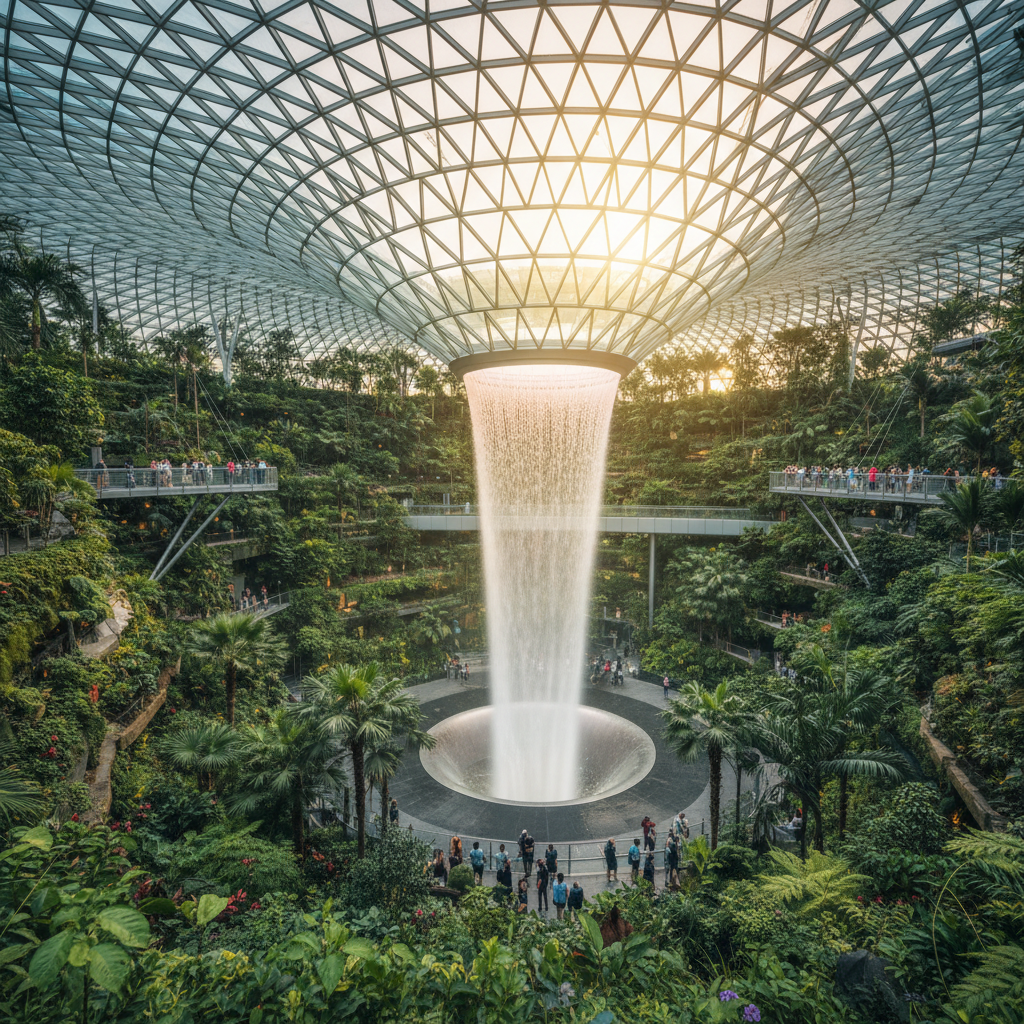
The conceptual leap at the heart of Jewel is deceptively simple: the airport is not a place you pass through on your way to somewhere else. It is a destination you choose to visit. That reframing sounds obvious in retrospect, but no airport operator at scale had committed the capital and design ambition required to operationalize it before 2019. Previous airport enhancement efforts, even ambitious ones, treated retail and dining as ancillary amenities layered on top of aviation infrastructure. Jewel inverted that hierarchy. The Rain Vortex and the Shiseido Forest Valley are the primary attraction. The airport connection is the access mechanism.
The 40-meter indoor waterfall at the center of a glass dome covering 135,700 square meters is not a decoration. It is a structural organizing principle. Every retail level, every pedestrian circulation route, and every sightline in the building is oriented toward it. The waterfall draws visitors inward and upward through seven levels of retail and dining, and then continues up to the Canopy Park on the top level. This architecture of attraction is what separates Jewel from a well-designed airport mall. It creates dwell time through spatial experience rather than commercial necessity.
Previous approaches to improving the airport experience had focused on reducing friction: faster check-in, shorter security queues, better wayfinding. Jewel does not compete in that category at all. It adds something orthogonal: a reason to arrive early or visit without flying. The 55 to 65 percent non-traveler visitor share in Jewel's opening months is the metric that proves the conceptual breakthrough worked. CAG had effectively created a new customer category for an airport, one that had never existed before at this scale.
What technology, process, business model, or service design architecture enables this?
Jewel functions through three interlocking systems: physical integration with the airport, a curated tenant ecosystem, and environmental engineering that sustains the nature experience year-round. On the physical side, Jewel sits on what was previously a surface car park between Terminals 1, 2, and 3. It connects to all three terminals via air-conditioned pedestrian link bridges and the airport's SkyTrain system, meaning travelers can move between their gates and Jewel without re-clearing security. That seamless connectivity is operationally critical: it allows transit passengers with two or three hours between flights to use Jewel's attractions without the friction of re-entry procedures.
The Rain Vortex operates on a rainwater harvesting and recirculation system capable of processing up to 10,000 gallons per minute during heavy rainfall. Singapore's tropical climate, which delivers consistent rainfall year-round, feeds the system continuously. Water is collected from the dome roof, filtered, and recirculated through the 40-meter drop. The Shiseido Forest Valley surrounding the waterfall contains approximately 2,000 trees and 100,000 shrubs representing over 100 species, maintained in a controlled environment where advanced HVAC systems, strategic planting, and high-performance glazing manage temperature and humidity despite the outdoor climate. Ateliers-Museo handled the landscape design, and the horticulture team manages the living plant collection on an ongoing basis.
The commercial architecture uses a tenant mix strategy that blends international flagship stores with Singapore-specific brands, many making their airport debut, alongside food and beverage operators at multiple price points, and ticketed attractions such as the Canopy Park, Hedge Maze, and play installations. Over 300 retail and food and beverage outlets achieved near 100 percent occupancy at opening. Main contractor Takenaka Corporation executed the build, with BuroHappold Engineering handling the structural engineering of the dome and Gardner & Theobald providing project management. The entire project used advanced BIM throughout design and construction to coordinate the thousands of unique components and manage clash detection across a live airport environment.
What measurable, quantified outcomes has this produced?
Jewel attracted more than 50 million visitors in its first six months of operation, from April to October 2019, a figure that exceeded CAG's internal projections. The non-traveler share of that audience ran between 55 and 65 percent in those initial months, against a pre-opening projection of approximately 30 percent. That gap between expectation and outcome is the clearest measure of how significantly the concept outperformed its own business case. Local Singaporeans and non-flying tourists were visiting Jewel as a leisure destination in numbers the operator had not anticipated.
Changi Airport carried 68.3 million passengers in 2019, up 4 percent year-on-year from 65.6 million in 2018. Isolating Jewel's direct contribution to passenger growth is not possible given multiple variables, but the airport's sustained growth trajectory in its opening year suggests the complex did not cannibalize aeronautical performance. Changi Airport held its Skytrax World's Best Airport ranking across 2013 to 2020, with Jewel consistently cited as a contributing factor, and reclaimed that title in 2023 after pandemic disruption. The retail occupancy rate of near 100 percent at opening, across more than 300 tenants, indicates strong commercial demand from operators who assessed the footfall numbers and committed. Specific tenant sales figures remain proprietary, but anecdotal reporting from retailers in the opening period described performance above expectations. The S$1.7 billion capital investment, financed through CAG and partner contributions including a S$10 million donation from the Ng Teng Fong Charitable Foundation, represents one of the largest single investments in airport experience infrastructure anywhere in the world.
What challenged implementation? What could go wrong or limit adoption?
The capital requirement is the single largest barrier that Jewel creates for itself as a model. At S$1.7 billion, the investment is accessible only to airport operators with either sovereign backing, exceptional balance sheets, or structurally reliable long-term revenue. CAG benefits from Singapore's government as its ultimate principal, which provides a risk tolerance and planning horizon that most commercially operated airports cannot match. Any replication attempt at a privately operated or debt-funded airport would face a fundamentally different capital structure conversation.
Operationally, building a 10-story complex over a live car park integrated with three active terminals involved risks that Takenaka Corporation and the project team managed through meticulous phasing, but the margin for error in a live aviation environment is extremely low. A construction incident affecting flight operations would have carried reputational and financial costs far exceeding any construction schedule overrun. The project also required alignment across multiple Singapore government agencies, including the Civil Aviation Authority, the Urban Redevelopment Authority, and the Singapore Tourism Board, a coordination task that is straightforward in Singapore's planning environment but would be substantially more complex in jurisdictions with fragmented regulatory authority.
Post-opening, Jewel's visitor model depends heavily on Singapore's position as a regional tourism hub and on a dense, high-spending local population. The COVID-19 pandemic demonstrated the vulnerability of that model: international visitor flows collapsed in 2020, and the non-traveler share, while structurally resilient compared to aviation-dependent revenue, still suffered from mobility restrictions. Any future disruption to Singapore's tourism inflows, whether from regional competition, geopolitical friction, or public health events, would materially affect Jewel's commercial performance. The complex also carries ongoing operational costs related to maintaining 2,000 trees and 100,000 shrubs in a climate-controlled indoor environment, a cost that has no equivalent in conventional airport retail operations.
What does this unlock, influence, or make possible beyond its immediate context?
Jewel's most significant second-order effect has been on how airport operators globally frame the concept of non-aeronautical revenue. Before 2019, the dominant model for airport commercial development was optimizing retail and food and beverage within the security perimeter for captive travelers. Jewel demonstrated that an airport campus could generate substantial footfall from people who never intended to fly, which expands the addressable market for airport operators by an order of magnitude. Airport planning consultancies, operators in the Gulf, and several European hub airports have since referenced Jewel when articulating long-term commercial development strategies.
The project accelerated a conversation already underway about the 'aerotropolis' concept, where airports function as economic and social anchors for their surrounding regions rather than purely as aviation infrastructure. That conversation has influenced master planning discussions at airports including Amsterdam Schiphol, Dubai International, and several major Chinese airports that are building integrated retail and hospitality precincts adjacent to their terminals. None of these projects replicate Jewel at its full scale or complexity, but the Jewel model provided a financially credible reference point that made the business case for ambitious airport destination development easier to construct.
For Singapore, the ripple effect extends into national brand positioning. Jewel became an internationally recognized architectural landmark within months of opening, generating global media coverage that reinforced Singapore's identity as a city that executes ambitious infrastructure at world-class quality. That coverage operates as a form of tourism marketing with no direct cost to the Singapore Tourism Board. The design itself, and specifically Moshe Safdie's integration of nature and commerce at scale, has influenced architectural discourse around biophilic design in large public buildings, extending the project's influence into sectors well beyond aviation.
What would another organization need to replicate or adapt this?
An organization seeking to adapt the Jewel model needs to begin with an honest assessment of three preconditions before any design conversation takes place. First, it needs control over a significant contiguous land parcel adjacent to or integrated with its terminal campus. Jewel used a surface car park; the equivalent at another airport might be an underutilized cargo facility, a surface lot, or an aging terminal scheduled for decommissioning. Without that land, the physical integration that makes Jewel work, specifically the airside and landside connectivity without security re-clearance, is not achievable. Second, the operator needs a long planning and payback horizon. The concept originated at CAG in 2007, broke ground in 2014, and opened in 2019. An organization expecting a five-year return on investment is not the right candidate. Third, the local market needs to support a non-traveler visitor base. Jewel works in Singapore because the city has a dense, affluent local population and draws millions of international tourists annually. An airport in a low-density catchment area or a weak tourism market will not generate the non-traveler footfall that makes the commercial model function.
Assuming those preconditions are met, the capital structure requires careful construction. CAG's model combined its own balance sheet with tenant commitments and sponsorship. A public-private partnership structure, where the airport authority contributes the land and infrastructure shell while private operators fund the tenant fit-out and attractions, could lower the upfront capital requirement for operators without CAG's financial position. The tenant mix strategy is critical and under-discussed in most Jewel analyses: the combination of international brands seeking flagship exposure, local brands seeking a high-visibility platform, and ticketed experiential attractions is what sustains dwell time and repeat visits. Copying only the retail format without the experiential anchors produces a well-designed mall, not a destination.
The nature element is not optional cosmetic branding. The Rain Vortex and the Forest Valley are the primary draw for non-travelers, and their maintenance requires ongoing horticultural and engineering investment that needs to be budgeted as operational infrastructure, not as a marketing expense. Any organization that treats the green elements as a launch-phase attraction and then reduces maintenance investment will see visitor numbers migrate back toward the traveler-only baseline. The playbook is transferable in principle, but the full Jewel outcome is the product of a specific alignment of government backing, land availability, design ambition, engineering capability, and market conditions that took twelve years to assemble.