
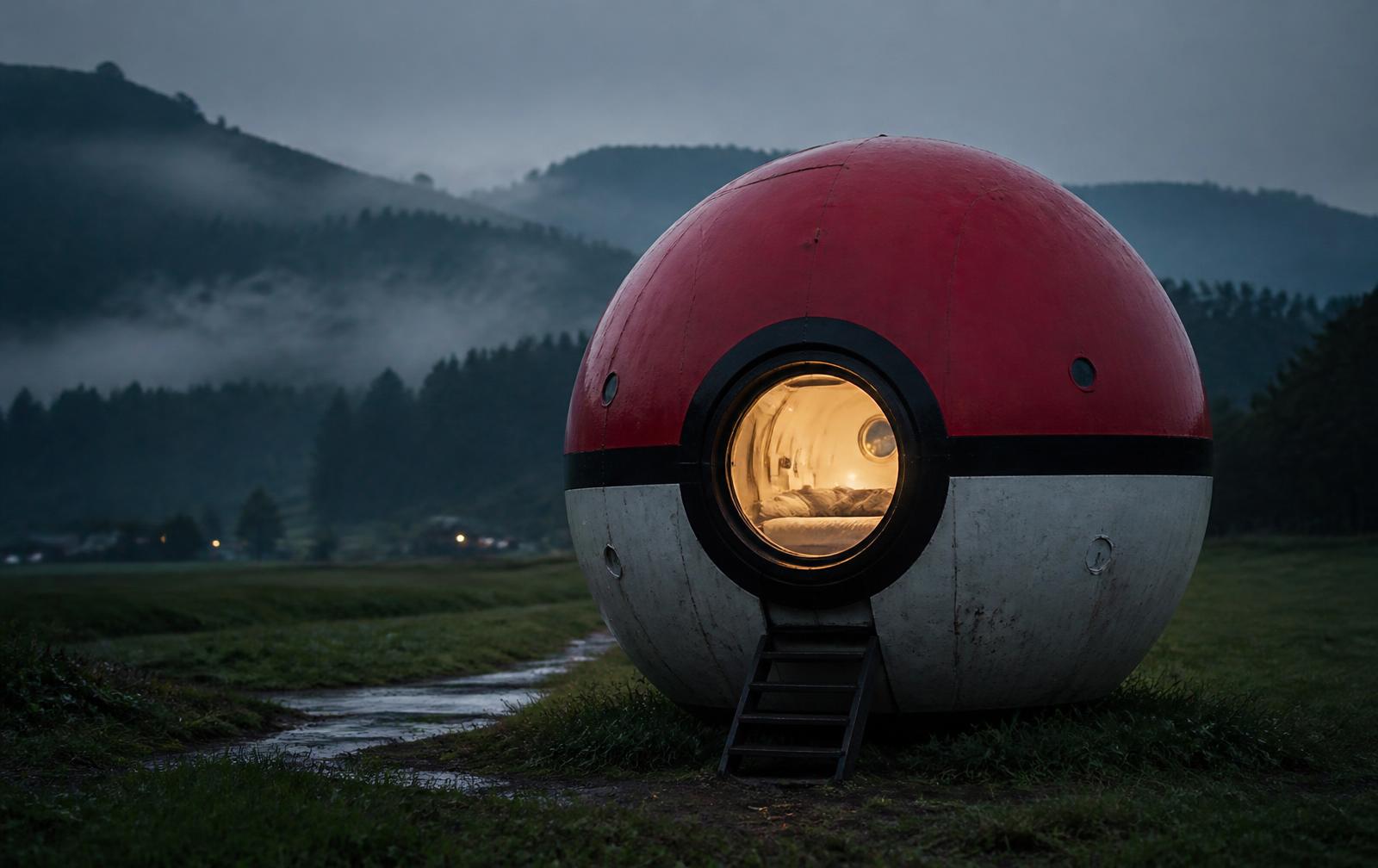
Pokémon Sleep x NOT A HOTEL: The Poké Ball Sleep Pod
    All Innovations
    Innovation.
    Travel
    Service DesignHotels & Accommodation✦ Pilot

    Pokémon Sleep x NOT A HOTEL: The Poké Ball Sleep Pod

    The Pokémon Company (Pokémon Sleep) with NOT A HOTEL · Japan · 2026

    "A single human-sized Poké Ball in rural Hokkaido turns a mobile sleep-tracking game into a physical, application-only overnight stay."
    Year
    2026
    Region
    Asia-Pacific
    Country
    Japan
    Sector
    Hotels & Accommodation
    Type
    Service Design
    Technology
    Mobile
    Stage
    Pilot
    ◈ Overview

    Pokémon Sleep and NOT A HOTEL built a habitable Poké Ball in Hokkaido, bookable only through a limited campaign.

    ◈ In Depth

    The design logic runs directly from the game's fiction, where a Poké Ball is described as a comfortable place for a Pokémon to rest. Scaling that object to human size gives the brand a piece of inhabitable architecture instead of an advertisement. NOT A HOTEL, founded in Japan in 2020, develops architect-designed residences that combine private ownership with hotel service and app-controlled access, so it brought an operating model rather than a set-build capability. Placing the sphere in open Hokkaido landscape rather than in a city ties the stay to a quiet rural setting consistent with the sleep theme, and distribution by application keeps the asset scarce while turning demand into first-party data for the game.

    ◈ Framework

    Innovation Impact Canvas

    An 8-dimension case study framework tracing the full lifecycle of innovation, from the problem that created the need, to the mechanism of change, to the lessons available for replication.

    01
    The Gap
    What specific friction, inequity, or missed opportunity in travel/tourism prompted this?
    Themed hospitality usually stops at decorated rooms inside conventional hotels, which reads as merchandising. Nothing existed that treated a globally recognised object as habitable architecture in a landscape setting, and mobile game engagement rarely converts into real-world travel demand.
    02
    The Trigger
    What change in technology, behaviour, regulation, or competition made this innovation possible or necessary NOW?
    Pokémon Sleep had turned rest itself into gameplay for millions of users, while NOT A HOTEL had built a business on architecture as the product. Both sides needed a way to move the sleep idea out of the phone and into a place people could actually stay.
    03
    The Breakthrough
    What is the core innovation - what changed, and why is it fundamentally different from what existed before?
    A functioning Poké Ball you can sleep inside, sited in open Hokkaido countryside and released not as a bookable room but as a limited application campaign.
    04
    How It Works
    What technology, process, business model, or service design architecture enables this?
    Pokémon Sleep and NOT A HOTEL designed and built one human-sized red-and-white sphere in Hokkaido, revealed in teaser images in early September 2026 with the full project unveiled on 15 September. Stays are not sold on booking platforms. Applicants register through official Pokémon Sleep channels and selected participants are invited to spend the night, with NOT A HOTEL providing the hospitality operating layer and app-based access it already uses across its residences.
    05
    The Impact
    What measurable, quantified outcomes has this produced?
    A mobile game gained a physical presence in the accommodation market and a news cycle across design, travel and gaming media. Hokkaido gained a landmark attached to a global fandom. NOT A HOTEL gained proof that its architecture-as-product model extends to licensed intellectual property, with application data flowing back to the game rather than to an online travel agency.
    06
    Friction & Risk
    What challenged implementation? What could go wrong or limit adoption?
    A single pod carries obvious limits. There is no occupancy story, no repeatable revenue and no scale without diluting the scarcity that drives interest. Spherical geometry makes interior comfort genuinely difficult, and the interior remained unseen at announcement, so the experience could still disappoint the imagery. Remote Hokkaido siting raises access, servicing and winter operating questions, and licensed intellectual property brings approval layers that slow any change. Outcomes rest on media reporting rather than published performance data.
    07
    The Ripple Effect
    What does this unlock, influence, or make possible beyond its immediate context?
    The project pushes themed accommodation from decorated interiors toward buildings shaped as the property itself, and it shows game publishers a route into travel that does not require operating hotels. It also reframes scarcity: one unit, awarded by application, generates more attention than a rolled-out room category.
    08
    The Playbook
    What would another organization need to replicate or adapt this?
    Pick an object your audience already recognises without a caption. Partner with an operator that can meet a real overnight standard rather than a film-set build. Site it where the landscape reinforces the theme instead of competing with it. Distribute access by application on your own channels to keep scarcity and capture first-party data. Stage the reveal in two beats, teaser then full unveiling, and keep the unit count at one until the concept is proven.
    ◈ Replicability

    Replicability Score

    An AI-evaluated measure of how easily and relevantly this innovation can be replicated by other tourism & travel sectors.

    8
    / 100
    Hard to Replicate

    The mechanic is cheap to copy for any brand with a recognisable object and a willing operator, and it requires one structure rather than a portfolio. What does not travel is the intellectual property: the effect depends on decades of built-in recognition, and a weaker brand produces a novelty shed. Regulatory approval for a permanent habitable structure on rural land, plus the operating standard needed for paying or invited guests, are the real constraints.

    Relevant for these sectors
    Hotels & AccommodationDestination MarketingExperiential & EntertainmentTechnology & Platforms
    ◈ Replicate

    How organizations can replicate this

    Key principles and transferable insights for adapting this innovation to other contexts.

    The transferable pattern is a brand-owned single unit built as media rather than as inventory. It needs an object the audience already recognises, a hospitality operator that can deliver a real overnight standard, a rural or scenic site that reinforces the theme, and application-based access that keeps scarcity intact while collecting audience data. Hotel groups can run the same play with any licensed property; destinations can run it with a locally iconic form. The discipline is to keep the unit count low and the reveal staged, because the value sits in attention and desire rather than in nightly rate.

    ◈ Score

    Innovation Score

    Editorial assessment across 8 weighted dimensions. Scores represent our judgment based on publicly available evidence, industry coverage, and documented outcomes. Scores are revised as new evidence emerges.

    Problem–Solution Fit (20%)82
    Commercial Impact (18%)68
    Experience Transformation (16%)91
    Scalability (14%)74
    Sustainability Alignment (12%)55
    Technology Sophistication (10%)58
    Industry Influence (6%)79
    Evidence Quality (4%)62
    ◈ Innovation Score
    Problem–Solution Fit (20%)82
    Commercial Impact (18%)68
    Experience Transformation (16%)91
    Scalability (14%)74
    Sustainability Alignment (12%)55
    Technology Sophistication (10%)58
    Industry Influence (6%)79
    Evidence Quality (4%)62
    Weighted Overall Score 73/100

    Full Analysis is available to Pro members. Upgrade to Pro.

    ◈ Details
    themed accommodationintellectual propertysleep tourismJapanexperiential marketingcapsule hotel

    Share this innovation

    Innovation.
    Travel
    Part of the Travel Intelligence Network

    © 2026 Innovation.Travel