What specific friction, inequity, or missed opportunity in travel/tourism prompted this?
Cruising had long marketed itself as a premium, all-inclusive vacation product, yet the actual guest experience was riddled with friction that contradicted that promise. Embarkation alone could consume two hours of a seven-night holiday: guests queued at terminals, filled out paper health forms, waited for identity verification, and received plastic keycards that frequently demagnetized. Once onboard, those keycards became a persistent annoyance, required for room entry, onboard purchases, and identification at the gangway, yet small enough to lose and fragile enough to fail. On a ship carrying 3,500 passengers, losing a keycard meant a trip to guest services during peak hours.
Beyond the keycard problem, the onboard service model was fundamentally reactive. Crew members had no real-time visibility into where guests were or what they had previously ordered or preferred. A bar waiter serving a returning guest had no way to know that the guest always ordered the same cocktail or had a nut allergy. Food and beverage delivery was anchored to fixed venues: if a guest wanted a drink by the pool, they walked to the bar. If they wanted room service, they called a number and waited. The ship, despite being a self-contained destination, operated with the service intelligence of a large hotel from the 1990s.
The personalization gap was equally significant. Cruise lines collected detailed guest data at booking but rarely activated it onboard. Despite knowing a family had booked a suite, celebrated an anniversary, or sailed six previous voyages, the ship greeted them with a generic experience indistinguishable from that of a first-time guest. For a product category competing against land-based luxury resorts and ultra-personalized boutique travel, this gap represented both a customer satisfaction problem and a commercial opportunity the industry was consistently leaving on the table.
What change in technology, behaviour, regulation, or competition made this innovation possible or necessary NOW?
Several forces converged between 2014 and 2017 to make the OceanMedallion concept viable. Consumer-grade Bluetooth Low Energy technology had matured to the point where small, battery-free devices could communicate reliably across large indoor spaces. Apple's iBeacon standard, launched in 2013, demonstrated that BLE could power location-aware retail and hospitality applications at scale. Simultaneously, the cost of deploying dense sensor networks had dropped significantly, making it financially feasible to instrument an entire cruise ship with thousands of readers rather than just doorways and payment terminals.
On the demand side, the post-2010 smartphone generation had fundamentally reset consumer expectations around frictionless transactions. Guests arriving on cruise ships in 2016 had Apple Pay on their wrists, Uber on their phones, and Amazon delivering packages to their doors in two hours. The contrast with the cruise keycard experience was jarring and increasingly hard for premium brands to justify. The contactless payment revolution, already transforming retail and transit, made physical swipe cards look anachronistic.
Within Carnival Corporation itself, the trigger was leadership. John Padgett, who joined the company as Chief Experience and Innovation Officer after years in the theme park industry, brought a Disney-influenced philosophy of total environment design to the cruise context. His vision was not to improve the keycard but to eliminate the entire category of friction it represented. Arnold Donald, then CEO of Carnival Corporation, provided the executive backing and capital commitment that turned the concept into a multi-hundred-million-dollar infrastructure program rather than a pilot experiment. The CES platform gave the initiative a public launch moment in January 2017 that set the ambition clearly for the entire industry.
What is the core innovation - what changed, and why is it fundamentally different from what existed before?
The conceptual leap behind the OceanMedallion was not digitizing the keycard. It was reconceiving the relationship between a guest's identity and the physical environment of the ship. Before the Medallion, identity was a point-in-time transaction: you presented your card, the system recognized you, and the interaction ended. The Medallion made identity continuous and ambient. The ship knew where you were at all times, which meant service could come to you rather than requiring you to go to it. That inversion, from guest-seeks-service to service-finds-guest, is the architectural breakthrough.
The Medallion itself is deliberately minimal: a 30-millimeter, battery-free disk carrying no personal data, only an encrypted unique identifier. All the intelligence lives in the network and the back-end profile, not in the device. This design choice solved both the security problem and the hardware maintenance problem simultaneously. A lost Medallion is worthless to anyone who finds it. Replacing it requires no data migration because the profile is entirely cloud-resident.
What made previous approaches insufficient was their scope. RFID keycards solved the physical access problem but ignored payment, personalization, and location. Mobile apps solved information delivery but required the guest to actively open them and assumed reliable smartphone battery life. The Medallion combined passive location awareness, contactless payment, keyless room entry, and a personalization engine into one wearable that the guest never had to think about. The guest's burden dropped to near zero while the data richness available to the crew and operations team increased exponentially. That asymmetry, where the guest does less and the ship knows more, is the core of what makes this different from any prior cruise technology.
What technology, process, business model, or service design architecture enables this?
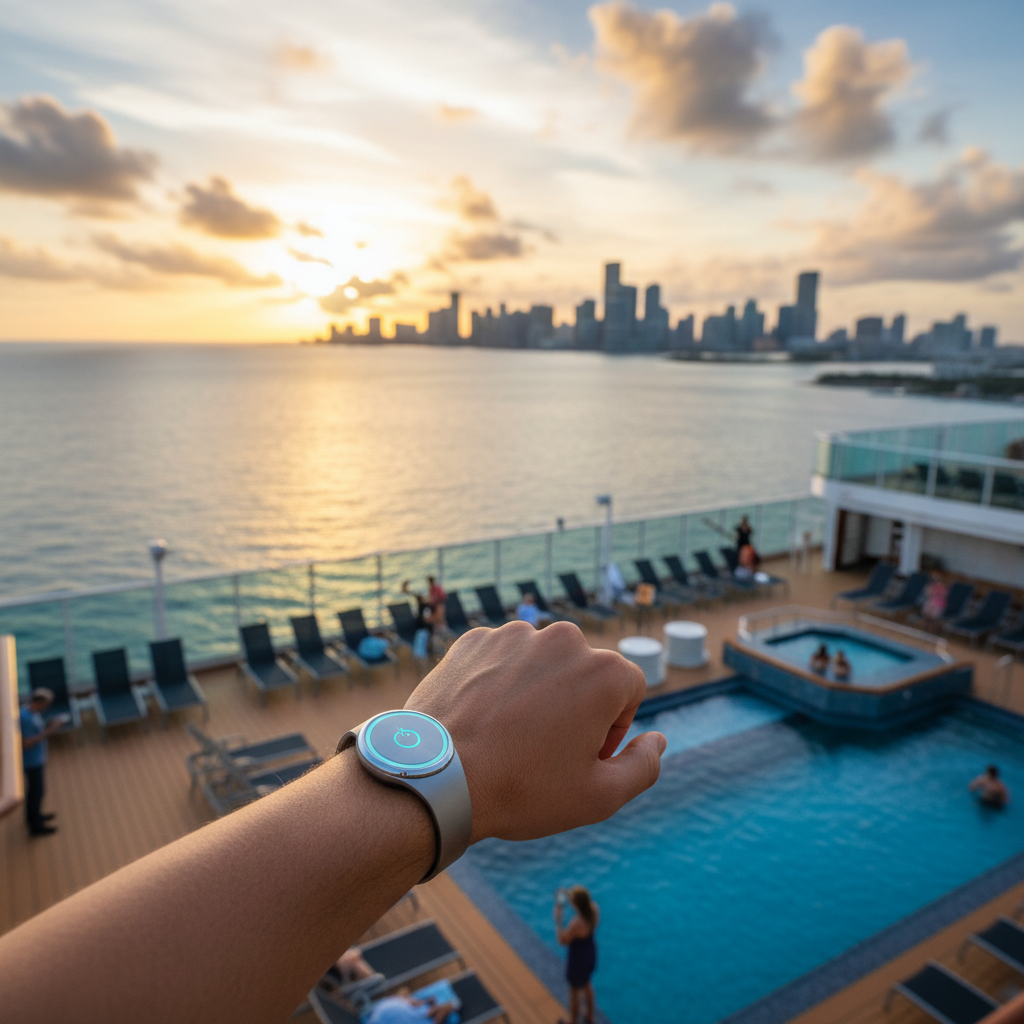
The physical Medallion communicates via two radio protocols simultaneously. Near Field Communication handles short-range, high-precision interactions: tapping to open a stateroom door or completing a payment transaction at a bar. Bluetooth Low Energy handles longer-range, continuous location broadcasting. A network of more than 7,000 sensors distributed across each ship, covering public decks, staterooms, crew corridors, and gangways, picks up each Medallion's BLE signal and triangulates position to within a few feet. The sensor network feeds into an onboard edge computing system that processes location data in real time, then pipes aggregated analytics to cloud infrastructure for deeper analysis and storage.
The guest-facing layer is the MedallionClass app suite, which operates across personal smartphones, stateroom televisions, and large interactive display panels called OceanBoards positioned around the ship. OceanReady handles pre-cruise digital check-in and document verification, compressing the embarkation process from a potential two-hour queue to under ten minutes for prepared guests. OceanNow allows food, beverage, and retail orders to be placed and delivered to whatever location the guest currently occupies, because the system already knows that location. OceanCompass provides real-time wayfinding and lets guests locate traveling companions who have opted into location sharing.
The back end runs a personalization engine that draws on booking history, loyalty program data, stated preferences, and observed onboard behavior to generate recommendations and alerts for crew members carrying handheld devices. When a guest approaches a bar, the bartender's device can surface that guest's name and preferred drink before a word is spoken. MedallionPay links the Medallion to the guest's onboard account, enabling contactless payment for every transaction onboard without the guest reaching for a wallet or card. The entire ecosystem required Carnival Corporation to retrofit each ship with upgraded Wi-Fi infrastructure, install the sensor network, train thousands of crew members across 14 vessels, and build a proprietary software platform largely in-house.
What measurable, quantified outcomes has this produced?
The most concrete deployment metric is fleet-wide coverage: by early 2022, all 14 active Princess Cruises ships were MedallionClass-enabled, making Princess the first cruise line to achieve full fleet integration of a wearable technology platform. The January 2017 CES Innovation Award provided independent third-party validation at launch, unusual for a hospitality product that had not yet entered commercial service. The infrastructure investment ran to hundreds of millions of dollars across R&D, hardware, retrofitting, software development, and crew training.
On the operational side, boarding times for guests who completed OceanReady pre-cruise check-in dropped from a historical range of 30 to 60 minutes to under 10 minutes. Because the Medallion is issued to every guest on MedallionClass ships, the effective adoption rate for core functions like keyless entry and MedallionPay is 100 percent, eliminating the partial-adoption problem that undermines most optional technology rollouts. Princess reported higher Net Promoter Scores on MedallionClass ships compared to non-Medallion ships, though the company has not published specific NPS differentials publicly.
Onboard revenue metrics remain proprietary, but the OceanNow delivery service is widely cited internally as a driver of incremental food and beverage spending, since frictionless ordering consistently increases purchase frequency in hospitality contexts. The pandemic halt between March 2020 and the fleet's phased return in 2021 and 2022 created a break in the commercial trajectory, but the contactless nature of the Medallion system became an unexpected operational asset as health protocols prioritized touch-free interactions. The full commercial return on the investment has not been independently verified, and Princess has not published a formal ROI figure.
What challenged implementation? What could go wrong or limit adoption?
The capital requirement alone places the OceanMedallion model out of reach for most cruise operators. Carnival Corporation's investment of hundreds of millions of dollars across a 14-ship fleet translates to a per-ship infrastructure cost that smaller lines cannot absorb. Beyond the financial barrier, the operational complexity of retrofitting an active cruise ship, a vessel that sails year-round with minimal dry-dock windows, with 7,000-plus sensors and upgraded networking infrastructure required meticulous scheduling and significant downtime management. The Regal Princess pilot in late 2017 revealed integration challenges that took months to resolve before the rollout accelerated.
Privacy risk is structural to the platform's design. The location tracking capability that enables OceanNow delivery and crew personalization is also a surveillance infrastructure operating on a captive, paying audience. Princess addressed this by making location sharing for family-finding features an opt-in and by ensuring the Medallion itself stores no personal data. But the broader data collection from guest behavior, purchase patterns, and movement throughout the ship raises ongoing regulatory exposure, particularly under GDPR for European itineraries and under evolving US consumer privacy frameworks. A data breach involving behavioral profiles of millions of cruisers would carry reputational consequences far exceeding typical hospitality incidents.
Technology dependency is a third category of risk. The entire guest experience on MedallionClass ships is now contingent on the sensor network, the Wi-Fi infrastructure, and the cloud back end functioning reliably in an ocean environment subject to connectivity interruptions, salt corrosion, and the physical wear of a ship operating continuously. A widespread sensor failure or app outage on a ship at sea cannot be resolved by calling a service technician. The pandemic also exposed a dependency risk of a different kind: a platform scaled to 14 ships generates enormous fixed costs whether those ships are sailing or anchored.
What does this unlock, influence, or make possible beyond its immediate context?
The OceanMedallion changed what premium cruise guests expect from the check-in experience, and those expectations do not reset when guests board a competing ship. Royal Caribbean responded by expanding the capabilities of its own mobile app, adding digital key functionality and onboard ordering features. Norwegian Cruise Line similarly invested in app-based services. No competitor has replicated the dedicated wearable or the sensor density, but the Medallion effectively raised the baseline standard for digital integration across the category. A cruise line operating with paper-based embarkation or swipe-card payment today faces a visible comparison disadvantage.
Beyond the cruise sector, the Medallion demonstrated that a large, complex hospitality environment, a floating city with 3,500 guests and 1,300 crew, could be instrumented for real-time location awareness at a commercially viable scale. That proof of concept has informed thinking in theme parks, convention centers, and large resort properties exploring similar ambient identity systems. The architecture, a passive wearable combined with a dense reader network and a cloud-resident profile, is a template that any large venue operator can study.
The platform also accelerated Carnival Corporation's internal digital capability. The investment in shipboard Wi-Fi, edge computing, and cloud integration built infrastructure that underpins operational functions well beyond the guest experience layer, including crew management, inventory tracking, and predictive maintenance. In that sense, the Medallion project funded a digital transformation of the corporation's operational backbone, not just its guest-facing product. The data asset accumulated from tracking guest behavior across 14 ships over multiple years represents a proprietary intelligence resource with long-term value for itinerary design, food and beverage planning, and targeted marketing.
What would another organization need to replicate or adapt this?
Any organization attempting to replicate the OceanMedallion at scale needs to begin with a fundamental capability audit rather than a technology procurement exercise. The Medallion works because Carnival Corporation built most of the core intellectual property in-house under a leadership team that understood both the technology and the operational environment. An organization without that internal capability would need to either acquire it through hiring or build a long-term partnership with a technology integrator willing to co-develop proprietary infrastructure rather than sell off-the-shelf hardware.
The financial sequencing matters enormously. Princess piloted on a single ship, the Regal Princess, before committing to fleet-wide rollout. That sequencing allowed the team to identify sensor placement failures, app workflow problems, and crew training gaps in a contained environment before multiplying those errors across 13 additional vessels. Any replication attempt should plan for a minimum 12-to-18-month pilot phase on one property before broader deployment, with explicit go/no-go criteria tied to guest satisfaction metrics and operational error rates rather than deployment milestones alone.
The crew training component is consistently underestimated in technology rollouts of this type. The Medallion delivers its personalization value only when crew members actively use the data their handheld devices surface. A bartender who ignores the guest name and preference prompt on their screen reduces the system to an expensive room key. Sustained behavioral change across a workforce of thousands, many of whom cycle through seasonal contracts, requires ongoing training investment, performance incentives, and management reinforcement rather than a one-time onboarding program.
For organizations that cannot match the capital investment, a modular approach is the practical alternative: digital check-in and document verification first, mobile payment second, location-based services third, with a smartphone serving as the identity device rather than a proprietary wearable. This path sacrifices the elegance of a hands-free, battery-free device but delivers a meaningful fraction of the friction reduction at a fraction of the cost. The OceanMedallion demonstrates the ceiling of what is possible; the smartphone-first path represents a reachable floor for mid-tier operators.