What specific friction, inequity, or missed opportunity in travel/tourism prompted this?
In 2016, the Faroe Islands existed in a peculiar blind spot for the global digital traveler. Google Street View, by that point a standard research tool for hundreds of millions of prospective tourists worldwide, had not mapped the archipelago. For a destination competing against well-documented European rivals, this absence created a tangible barrier: travelers could not virtually walk the cliffs of Sørvágsvatn or explore the turf-roofed villages of Gjógv before committing to a trip. In an era when pre-trip digital immersion had become a routine part of holiday planning, invisibility on Street View translated directly into reduced consideration at the destination-selection stage.
The problem compounded the Faroe Islands' existing challenge of geographic and perceptual remoteness. Situated in the North Atlantic between Norway and Iceland, the archipelago was unknown to large segments of the global travel market. Visit Faroe Islands operated with a marketing budget proportionally tiny compared to the national tourism boards of France, Germany, or even neighboring Iceland, which had successfully built global brand recognition through a combination of dramatic imagery and sustained investment. The Faroe Islands had neither the budget for sustained paid media nor the digital infrastructure that would allow organic discovery through mapping tools. The gap was not merely a technical oversight by Google; it reflected the structural disadvantage that small, remote destinations face in a digital landscape where visibility requires either significant resources or exceptional creative thinking.
What change in technology, behaviour, regulation, or competition made this innovation possible or necessary NOW?
Several forces converged in 2016 to make Sheepview 360 both possible and timely. Consumer-grade 360-degree cameras had reached a price point and ease of use that put them within reach of small organizations. The Samsung Gear 360, launched in 2016, cost a few hundred dollars and required no specialist operator. Google Street View had simultaneously opened a user-contributed content pathway, allowing individuals to upload geotagged panoramic imagery directly to the platform. This combination meant that a small tourism board could, in principle, begin mapping their own destination without waiting for Google's fleet of Street View cars to arrive.
The broader media environment also favored the campaign. By 2016, international news organizations and viral content platforms were actively hunting for stories that combined technology, quirky human interest, and visual spectacle. A small island nation strapping cameras to sheep to appeal to one of the world's most powerful technology companies contained every ingredient those outlets required. The timing also coincided with a period when Google was facing growing public discussion about the geographic gaps in Street View coverage, particularly in smaller nations and remote regions, which gave the campaign's central argument additional credibility and relevance with journalists covering the tech beat.
What is the core innovation - what changed, and why is it fundamentally different from what existed before?
The conceptual leap in Sheepview 360 was the decision to reframe a resource deficit as a narrative asset. Most small destination marketing boards facing limited budgets respond by producing conventional content at reduced scale: shorter video campaigns, fewer media placements, smaller press trips. Visit Faroe Islands did the opposite. It took the specific problem it faced, the absence of Google Street View coverage, and turned that absence into the story itself. The campaign did not advertise the Faroe Islands; it demonstrated the problem publicly, used the destination's most iconic residents as the vehicle for the demonstration, and directed the resulting attention at the one organization whose cooperation it needed.
What made this fundamentally different from previous destination marketing was the dual function of the campaign content. The sheep-mounted 360-degree images were simultaneously a media stunt, a direct appeal to Google, and actual functional Street View content uploaded to the platform. The campaign was not a simulation of action; it was the action. Previous approaches to raising a destination's digital profile had relied on lobbying, partnership negotiations, or simply waiting for Google to prioritize the location. Sheepview 360 compressed that process by making Google's non-response publicly visible and mildly embarrassing, while simultaneously generating the kind of international goodwill that made a partnership announcement attractive for both parties.
What technology, process, business model, or service design architecture enables this?
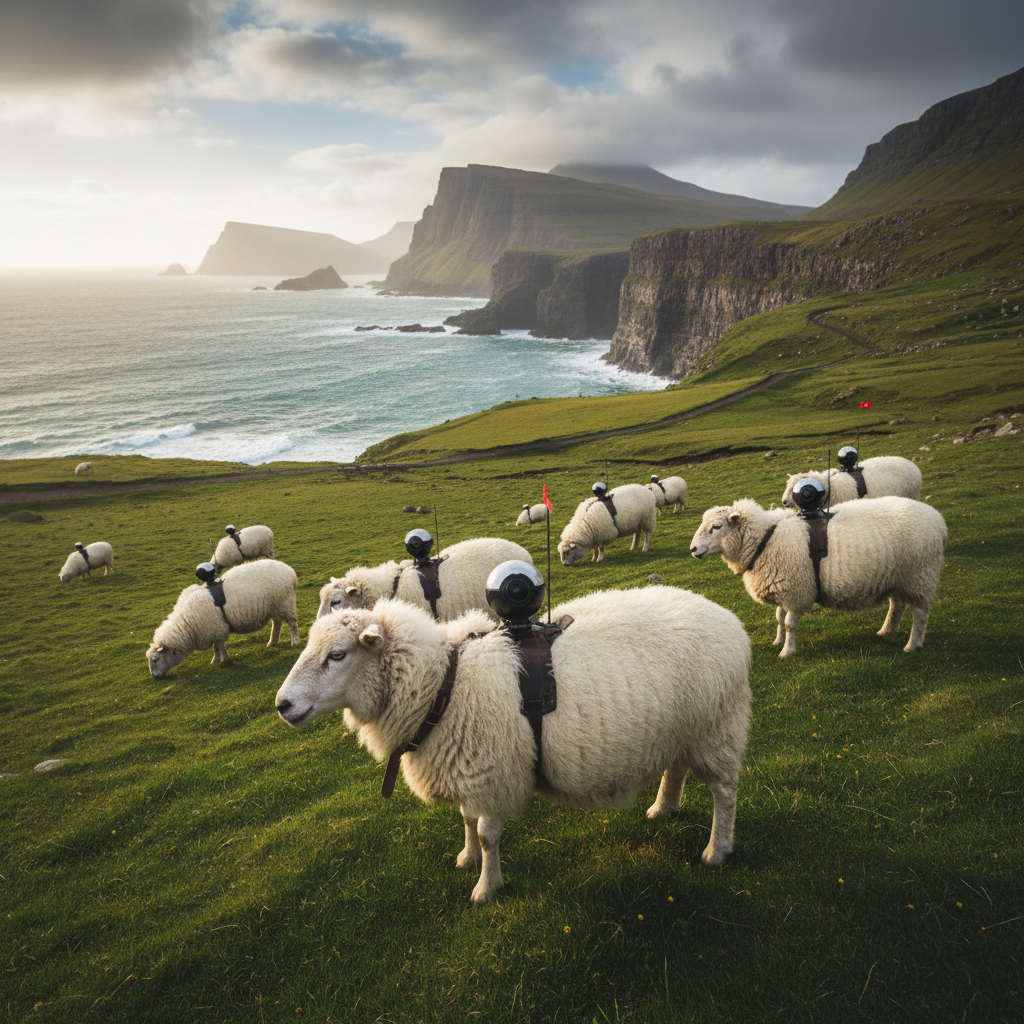
The operational architecture of Sheepview 360 was deliberately simple. Staff at Visit Faroe Islands worked with local sheep farmers to design and fit lightweight fabric harnesses onto five sheep. Each harness held a consumer 360-degree camera, positioned high on the animal's back to maximize the field of view over the landscape. A solar-powered GPS tracker attached to each rig transmitted location data to a smartphone application monitored by Durita Andreassen, the campaign's primary architect. She used that data to locate the sheep, retrieve the cameras, and download the footage.
Images were geotagged using the GPS coordinates recorded during each sheep's roaming session and then uploaded to Google Street View via the platform's user-contributed content functionality. A dedicated website, sheepview.com, served as the public-facing hub, displaying the sheep's routes on an interactive map and embedding the captured 360-degree imagery for visitors to explore. The campaign video, which featured Andreassen explaining the initiative and making a direct on-camera appeal to Google, was distributed to international media with a coordinated press release. Social media activity used the hashtags #wewantgooglestreetview and #sheepview360 to build public support and direct attention toward Google. The entire technical execution relied on off-the-shelf consumer hardware, custom-sewn fabric, and standard web publishing tools, with no proprietary technology involved.
What measurable, quantified outcomes has this produced?
The campaign's media reach was extraordinary relative to its budget. More than 200 international outlets covered the story, including the BBC, CNN, The Guardian, The New York Times, National Geographic, Mashable, and Lonely Planet. Estimated total media impressions exceeded one billion, a figure that represents earned coverage worth several million dollars in equivalent advertising value for a tourism board that could not have purchased that exposure through conventional media buying.
The most concrete outcome was Google's decision to send a full Street View team to the Faroe Islands in late 2016 and early 2017, deploying Street View cars, Trekker backpacks, and professional 360-degree camera equipment to map the entire archipelago. The islands moved from complete absence on Street View to comprehensive coverage as a direct result of the campaign. The sheepview.com website attracted tens of thousands of daily unique visitors at peak traffic, and the campaign generated hundreds of thousands of social media interactions. While Visit Faroe Islands has not published specific booking conversion data linked to the campaign, the destination's profile was demonstrably elevated among audiences who had no prior awareness of the islands. The campaign has since been cited in marketing industry case studies and academic syllabuses as a benchmark example of earned media strategy for under-resourced destinations.
What challenged implementation? What could go wrong or limit adoption?
The campaign's most obvious operational risk was animal welfare. Attaching camera rigs to sheep required cooperation from farmers who understood their animals and could assess whether the equipment caused distress. Had the harnesses been poorly designed or had the sheep shown signs of discomfort, the story would have shifted from charming to exploitative very quickly. The campaign team worked closely with local farmers to ensure the rigs were lightweight and non-invasive, but this dependency on animal subjects introduced an unpredictability that a purely human-operated campaign would not have faced.
The viral outcome was also entirely unpredictable and unrepeatable on demand. Sheepview 360 worked because it was the first of its kind, because the narrative was perfectly structured for international media, and because the timing aligned with growing public interest in Street View coverage gaps. A follow-up campaign attempting the same mechanic would almost certainly generate a fraction of the coverage. The model's deeper limitation is that it solved a one-time problem: once the Faroe Islands had Street View coverage, the specific premise of the campaign could not be reused. Visit Faroe Islands could not appeal to Google for the same thing twice. Any destination attempting to replicate the approach also faces the first-mover disadvantage; the novelty that drove global pickup in 2016 no longer exists for animal-mounted camera concepts.
What does this unlock, influence, or make possible beyond its immediate context?
Sheepview 360 shifted the conversation in destination marketing about what constituted a viable campaign for small or under-resourced tourism boards. Before 2016, the conventional wisdom was that global media reach required either a substantial paid media budget or a major news event. The campaign demonstrated that a clearly defined problem, an authentic local hook, and a direct public appeal to a named corporate party could generate comparable reach at a fraction of the cost. Tourism boards in small island states, landlocked nations, and remote regions began examining their own mapping gaps and digital invisibility as potential campaign starting points rather than background problems to quietly manage.
The campaign also influenced how Google engaged with destination marketing organizations in subsequent years. The public pressure created by Sheepview 360 made it easier for other small destinations to initiate conversations with Google about Street View expansion, because Google had demonstrated that such partnerships generated positive global coverage for the company. The model of a destination tourism board producing its own Street View-compatible content and uploading it via the user-contributed pathway also gained traction, with several smaller destinations adopting similar DIY mapping approaches. Within the travel PR industry, the campaign became a standard reference point for discussions about earned media strategy, authenticity in destination marketing, and the use of constraint as a creative driver.
What would another organization need to replicate or adapt this?
An organization seeking to adapt the Sheepview 360 model needs to start by identifying a concrete, nameable gap in their destination's digital infrastructure or global visibility, one that has a specific corporate or institutional actor responsible for filling it. The campaign worked because it had a clear antagonist, not a villain but an identifiable party whose inaction created the problem. Generic destination awareness campaigns do not generate the same narrative tension. The gap must be real, demonstrable, and capable of being illustrated through action rather than assertion.
The second structural requirement is a locally distinctive element that carries authentic meaning within the destination's identity. The sheep in the Faroe Islands were not chosen arbitrarily; they outnumber the human population, they define the landscape, and they are immediately recognizable as symbols of the islands. Any replication needs an equivalent: an animal, a craft, a geographic feature, or a cultural practice that belongs specifically to that place and cannot be transplanted to a generic marketing context. A destination that selects a vehicle simply because it looks unusual will produce content that reads as manufactured rather than genuine, and international media gatekeepers will assess it accordingly.
Budget requirements for the technical execution are genuinely low. Consumer 360-degree cameras, custom fabric harnesses or mounts, GPS trackers, a simple website, and a well-produced video can be assembled for well under ten thousand dollars. The investment that cannot be purchased is the media relationships needed to seed the story internationally and the editorial judgment to frame the campaign in a way that is immediately legible to journalists across different languages and cultural contexts. Organizations without in-house PR capability should budget for an agency with international media contacts. The sequencing matters: the video and press materials need to be ready before any public posting, because the story will move faster than the team expects once the first outlet publishes.